Common knowledge

Chapter I · The known world

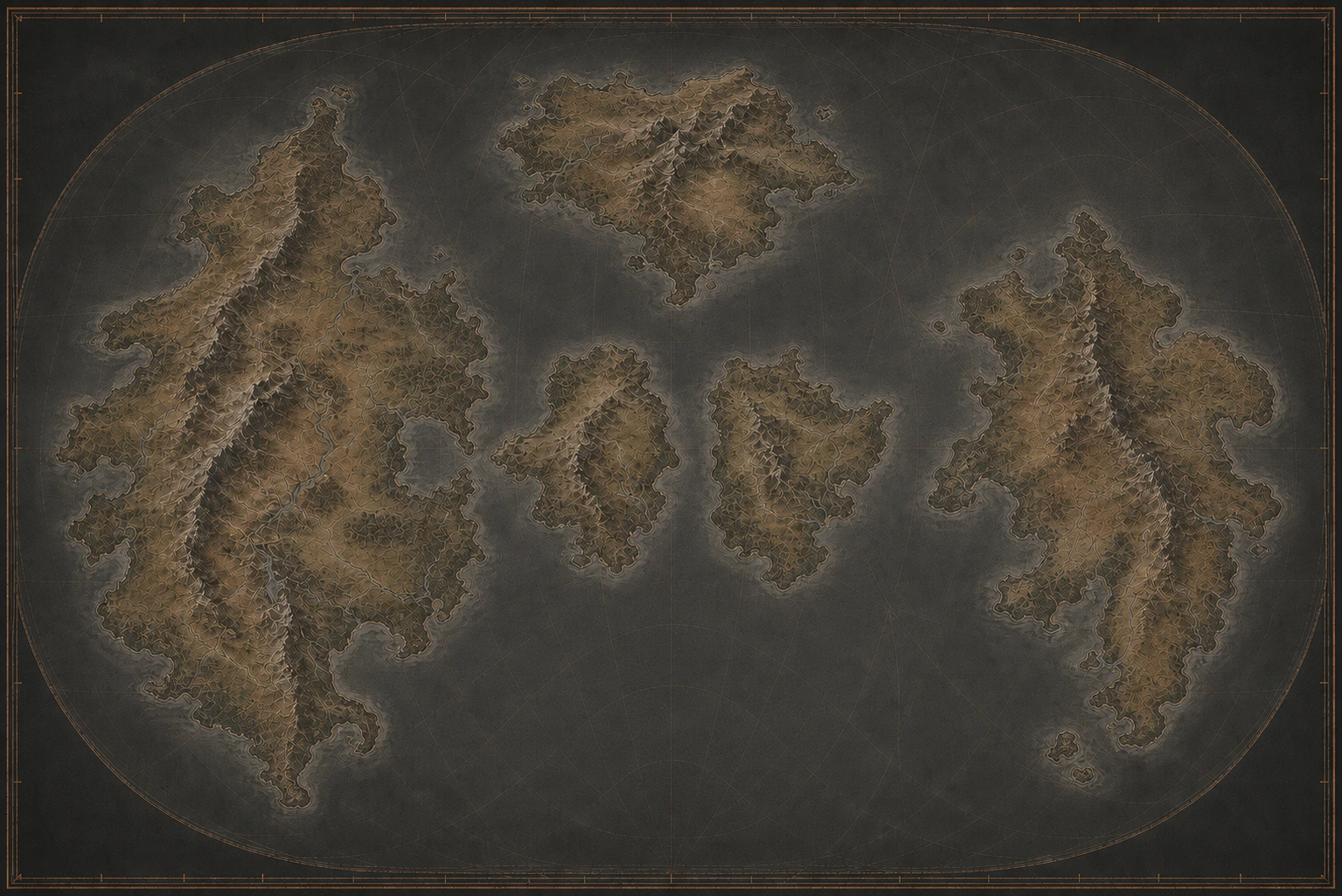
The Still is the map.

One connected body wraps the sphere, and arms of it reach up between the landmasses. You choose which arm to cross, and how wide it is where you cross it.

Five continentsOne connected bodyNo surface passage

Drag to pan. Pinch, double click, or use the controls to magnify, up to just under twice the plate size. Arrow keys pan; plus and minus magnify; Home resets. Every place on the chart is also listed beneath it.

Southern coast, as first returnedTwo returns, and they did not agree. Taken off. — 3rd yr of the armisticeThe wide arm, Ilyrion to CoravantCrossing-time returned without a reliable beginning. Left blank on a sheet this size. — 6th yrI have drawn the Scatters onto this plate twice and taken them off twice. They are in the world. They are not on this chart. — 8th yr
Plate V · interactiveThe world, as presently claimed.Robinson-style plate over the topology ledger · coasts provisional
Layers
Amendments on this plate
  • Southern coast, as first returned Two returns, and they did not agree. Taken off. — 3rd yr of the armistice
  • The wide arm, Ilyrion to Coravant Crossing-time returned without a reliable beginning. Left blank on a sheet this size. — 6th yr
  • I have drawn the Scatters onto this plate twice and taken them off twice. They are in the world. They are not on this chart. — 8th yr
Provisional · relative topology onlyWhat this plate claims
Established
  • Five continents, plus the Scatters.
  • Ilyrion, Harrowmark, Coravant, Vorn, the Longreach, Kaerys, and the Thread are frozen chart names.
  • Ilyrion largest; Vorn northern; the Longreach opposite Ilyrion.
  • Harrowmark across the Thread from Ilyrion; Coravant beside Harrowmark.
  • One connected Still, forming the Belt and every arm.
Provisional
  • Every coastline, island, relief mark, and inland water.
  • Scale, graticule, and projection geometry.
  • Route courses, borders, and the fog’s current reach.
  • Regional variants beyond the five frozen local names for the Still.
Crossings, to scale by quickened hours

Scaled by the time a quickened craft needs, which is recorded. Width in miles is not, apart from the Thread. Steam takes six times as long where it can go at all, and cannot attempt the Belt.

Chart reset to the full world.

01

Dead water

Common knowledge

Becalmed air over a surface that quietly unmakes whatever touches it. Surface ships that went in did not come out, and after enough centuries of proving that, people stopped trying.

Contact greys material, takes its integrity and its buoyancy, and lets it settle with little or no splash. A sound hull can put down on ordinary water in an emergency and many still can — river, lake, and enclosed coastal basins never changed. None of that buys a hull one second on the Still.

Crews call crossing it going grey. They also use the phrase for dying, in the same conversation, without appearing to notice.

Distance and isolation are different measurements. An island two days away is absolute if nothing can float between.
Witnessed

What a chart cannot hold

The law is clearest where somebody works beside it.

Four records from the folio: infrastructure, closure, contact, and recovery. None treats the Still as scenery, because none of the people in them can afford to.

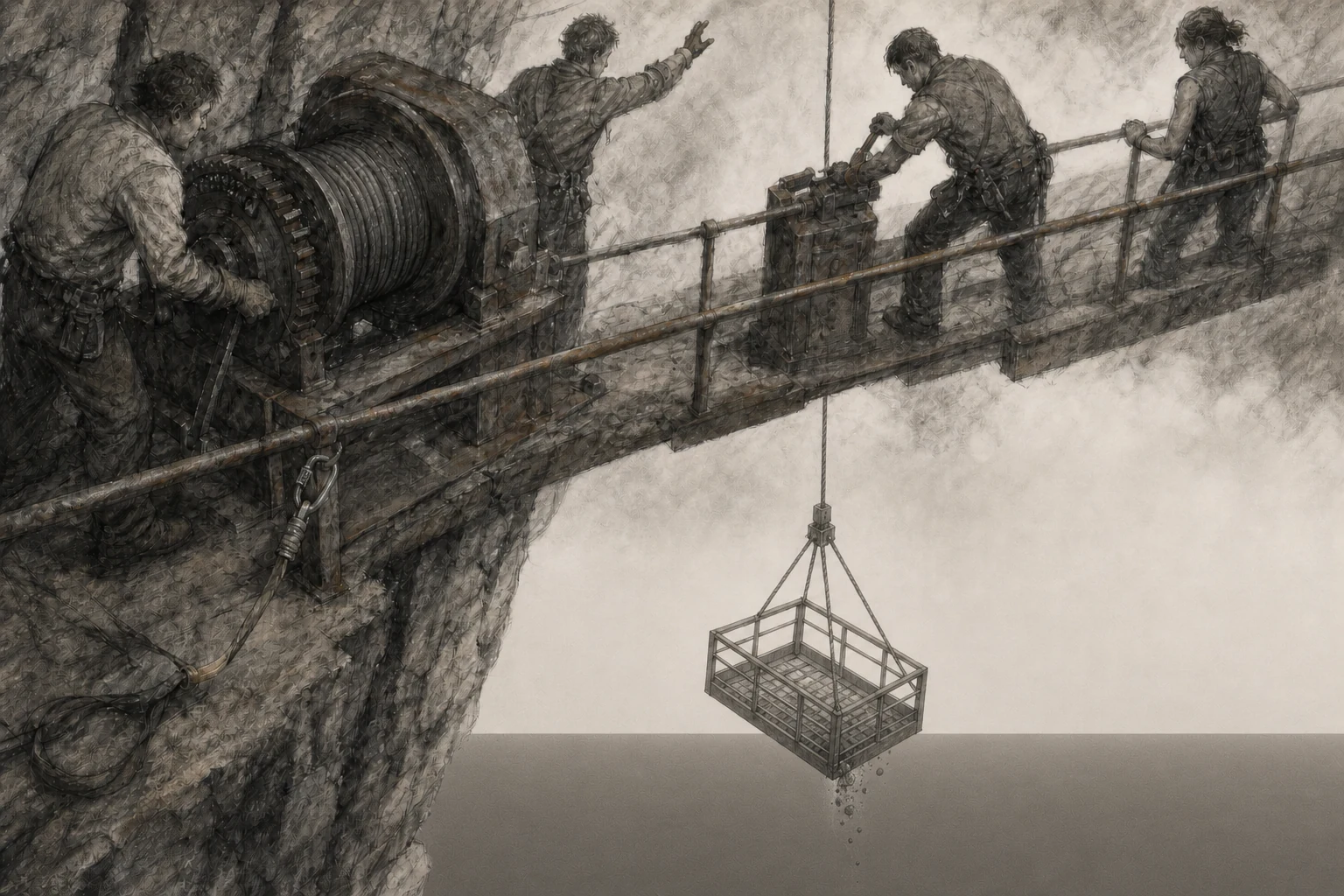
A suspended salvage cage loses one corner on contact with the perfectly flat Still while a crew arrests the winch drum
WSS–04Field notationWitnessed

The load touches.

An empty recovery cage went a little too far below the fog lid and one lower corner met the surface. The corner greyed, folded, and went down without a splash worth the name. Nothing in the plane moved.

The surveyor’s note
Vantage
Clipped into the safety recess beside the outer recovery cantilever, sketching the brake and clearance mechanism, which is what I had asked to see.
Before, after
The crew were testing the descent limit on the first calibration lift of the morning. The brake caught late. Afterwards they cut the cage free and locked the hoist for inspection.

Graphite and charcoal, and the page is unfinished at the lower edge because I stopped drawing. I have watched four of these and I still have no useful account of the mechanism. What I can record is the procedure, which is excellent, and the fact that nobody looked at it for long.

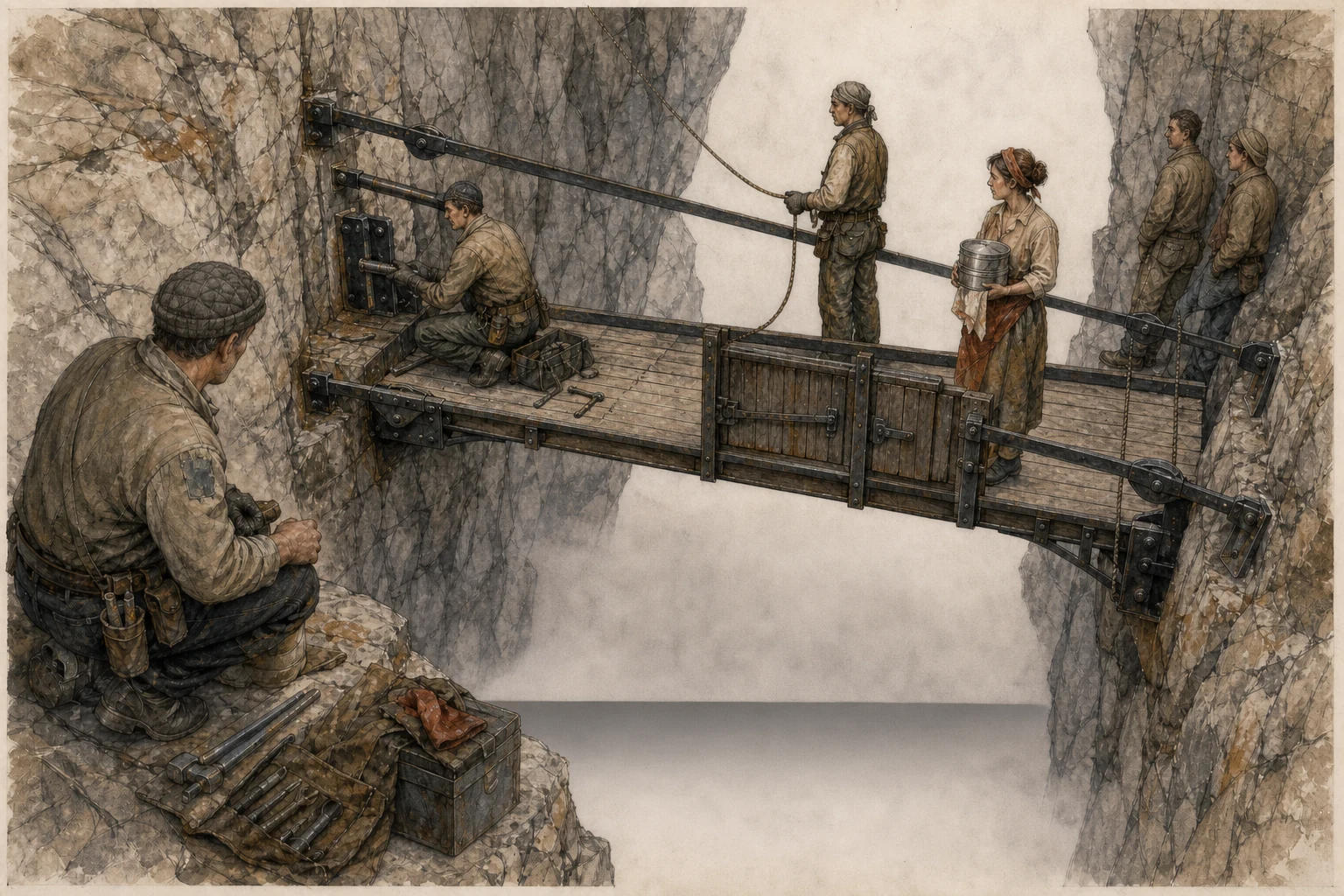
Workers maintain a narrow bridge whose permanent supports are anchored only in opposing dry cliffs above the Still
WSS–02Travel plateCommon knowledge

The bridge has no feet.

Every permanent member is anchored into dry cliff. When the upper anchor is replaced the gate closes, and a closed gate stops the midday meal as reliably as it stops the work route.

The surveyor’s note
Vantage
The upper dry-yard ledge, behind a second mechanic’s tools, after a morning spent waiting for the repair to reopen the route.
Before, after
The mechanic had withdrawn the worn pin and closed the gate. The wedge seated, the load test passed, and the cook crossed before the tins went cold.

Several hours of enforced waiting bought a proper plate rather than a hurried mark. I recommend the position to anyone who wants to understand how these stations actually eat.

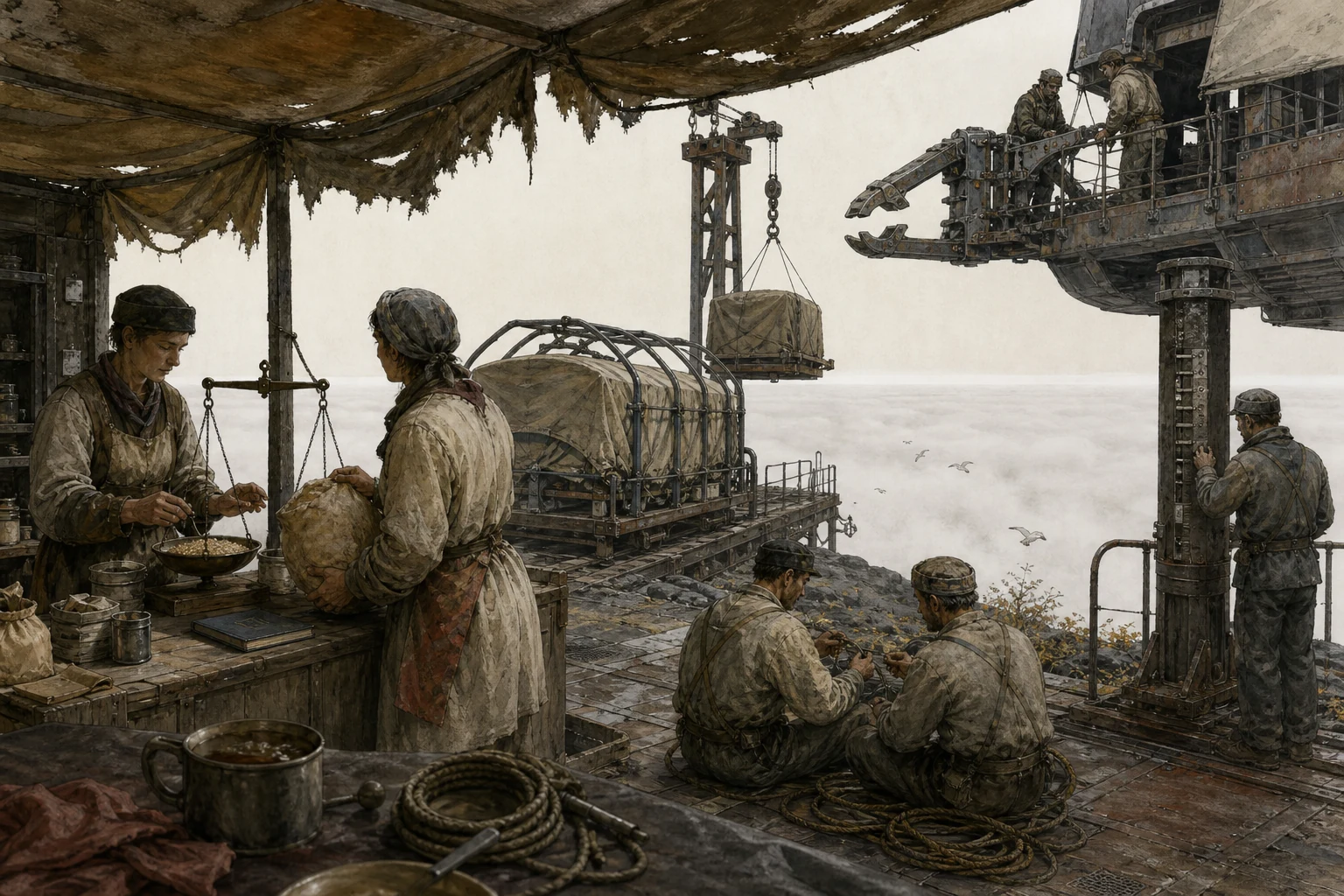
A grounded salvage crew takes supplies on account and repairs gear while high fog closes the aerial work
WSS–03Travel plateTrade knowledge

Second cancelled shift.

High fog closes salvage. The clerk issues staples on account, the riggers splice line they were not going to splice today, and the season quietly acquires a debt nobody has agreed a rate for yet.

The surveyor’s note
Vantage
Under the mess awning, four days into waiting for outward passage.
Before, after
A freighter had just clamped to the mast and the clerk opened its weather cover. The next sack was weighed, the account book closed, and the riggers went back to repairs rather than to a launch.

I recorded this because I had been told, more than once, that a bad fog year is a matter of lost wages. It is a matter of borrowing, and the borrowing is arranged on the same platform as the flour.

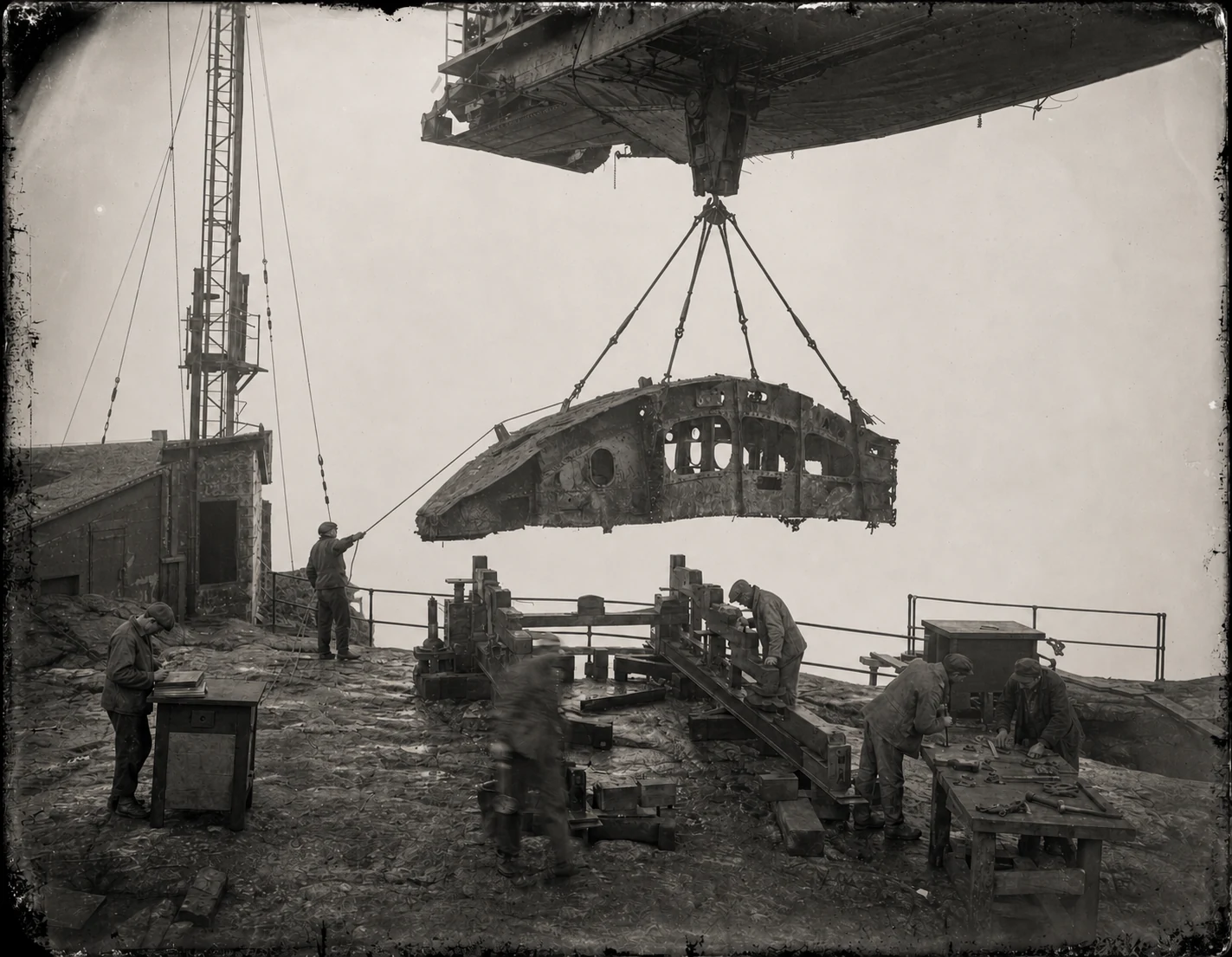
An airship lowers a recovered structural frame section onto a processing cradle built on dry station rock
WSS–05Plate photographTrade knowledge

First load on the dry cradle.

Scatters salvage is an aerial industry that lands on rock. The section comes up through the fog without any line touching the surface, and a grader with a hammer decides in about four seconds what a week of flying was worth.

The surveyor’s note
Vantage
Behind an expedition plate camera on a fixed inspection balcony. The station wanted an exposure for a salvage claim and I wanted the exposure.

The camera is heavy, slow, and unkind to anybody who moves. What survives is the cradle, the bench, and the clerk beside a closed ledger — which is a fair summary of where the value in this trade actually sits.

02

The wrecks

Trade knowledge

Centuries of failed crossings lie in the fog, and the only way to reach any of them is from above.

A fog year is one where the Still sits low and more of them are workable. Salvage crews live for them and die in them. In a high year the shifts are cancelled, the clerk issues flour on account, and the season quietly acquires a debt at a rate nobody has agreed. The whole economy of the Scatters is that arithmetic, repeated.

Salvage is a trade, a gamble, and a reliable way to stop being anywhere. That is three separate reasons for a family to have someone out there.

Six places to begin

Where did the world leave its mark on you?

The names below are the ones printed on current Kaerys charts. Other regions use other words, and several of them will tell you theirs are older.

01

The imperial heartland

Ilyrion

Largest of the five. Four centuries of dynasty, ninety years of world power, and eight years of decline. Kaerys holds its shore of the Thread; the capital is eight days inland and quietly broke.

Mosaic and fortress: layered pale stone, dark defensive massing, worn enamel, faded crimson, and nine older heraldic systems showing through imperial additions.

Were you raised inside the old story, beneath it, or against it?
02

Foundry country

Harrowmark

Across the Thread from Ilyrion. It built the steam fleets, then turned them against the people who commissioned them. Coldwater faces Kaerys from this side and answers to no Crown writ at all.

Shipyard commonwealth: black brick, salt-stained iron, white work tile, patched canvas, painted union marks, and machinery repaired in public.

What did the war build for your family — and what did it take?
03

The contested middle

Coravant

Administered once to the last stamp. Now a patchwork of successor states with inherited roads, excellent records, and disputed ruins.

Inhabited cadastral ruin: pale classical infrastructure, precise surveys, accumulated repairs, stamps, and painted borders over disputed stone.

Which vanished border do you still recognise?
04

Behind the wide arm

Vorn

Northern and independent, because reaching it was never worth what the crossing cost. Crystal changed that arithmetic within living memory and Vorn has opinions about it.

Dark shells, vivid rooms: weather-sealed black timber and stone concealing intense interiors, precise joinery, lenswork, and winter observation.

What arrived from the wider world that you wish had stayed away?
05

Country of the great herds

The Longreach

Directly across the world from Ilyrion. Its migration crossed the Belt itself. The herds changed course within the last decade, and every place-name there now records a stage of a journey that no longer happens.

Architecture made of routes: portable structures, harness grammar, layered textiles, tether fields, and settlements arranged around vanished stages of travel.

Which stage of a journey that no longer happens named your home?
06

Salvage country

The Scatters

Archipelagos in the shallows at the fog’s edge. Rock, scrub, seabirds, and mooring masts. A low-fog year makes fortunes; a high one makes debt. Its position stays off this chart.

Company stations: standardised gantries, measured exclusion zones, processing compounds, aerial approaches, and recovered material at the fog edge.

What did someone you loved go looking for in the fog?
Trade knowledge

A route is measured in what your vessel must carry.

Steam hauls its own fuel and water over a sea where it cannot put in, so it can only cross where the far shore sits inside its range. A quickened craft carries no fuel at all. That difference broke the imperial route monopoly. The empire survived it; its reach did not.

RouteBetweenQuickenedSteamNote
The ThreadKaerys ↔ Coldwater2 hoursAbout 12 hoursA little over two hundred miles. The shortest water in the world, by a long way.
A wide armCoravant ↔ IlyrionAbout 2 days5–6 days with tendersSteam only manages it by arranging to be met, which is expensive and occasionally does not happen.
A very wide armVorn ↔ anywhereAbout 5 daysTwo weeks; rarely survivedThis is the number that kept Vorn independent for four hundred years.
The BeltThe Longreach ↔ anywhereAbout 3 weeksNot attemptedThe main body, at its widest. People write books about crossing it, mostly posthumously.

For ninety years all long trade funnelled through one narrow crossing, because it was the only one steam could make. That is the whole reason Kaerys is worth fighting over, and the whole reason it is still being fought over eight years after a war ended.

Chapter II

The sky has a class system.

Five ways over the water, four centuries deep, and every rung resents the one above it.

Ways of flight