About four centuries ago
01
Riders
Dragon-borne flight under the rider orders. Crown doctrine says the bond was freely chosen.
Tiny cargo, enormous prestige, appalling risk. The old aristocracy remains; the dragons now refuse.Chapter II · The flight ladder
Four centuries of finding better ways over. Each rung remains a living culture even when its old crossing method fails or is displaced. The oldest carry the most respect and the least money; the newest broke a monopoly, which is why there was a war.

The dragon stood to full height and moved one shoulder out of line with the mounting stair. The rider asked for the whole check again. The stall hands found no defect, and the route slot passed unused.
Boundary The refusal and its institutional consequence are approved. Exact dragon anatomy, identity, harness, equipment, stair, court plan, stall count, and worker dress remain exploratory.
Four centuries, five rungs
Dragon-borne flight under the rider orders. Crown doctrine says the bond was freely chosen.
Tiny cargo, enormous prestige, appalling risk. The old aristocracy remains; the dragons now refuse.Whale, ray, eel, and herd-bearers carrying a family, a work crew, or in rare cases a community.
Real cargo for the first time. Mobile cultures, now displaced into ports that did not want them.Hot air, then lifting gas, over a curved inhabited hull.
The first crossing that asked nothing of an animal. Absorbed into the industry that followed it.Boilers, rotors, screws, fuel, water, and a printed timetable.
A scheduled crossing meant fleets, tariffs, and garrisons. It made the Nine Crowns a world power, and it is declining.Quickened matrices that judge lift, helm, and trim, carrying no fuel at all.
Buildable without an imperial shipyard and fuel-free across routes steam could not reach. It broke the imperial route monopoly, and then there was a war.Rivers, lakes, and enclosed basins kept shipwrights working after the Still ended open passage, so the first airships were hulls people already trusted, made flightworthy.
Later yards kept the curved inhabited whole even after lift, drive, and service changed beyond recognition, because it stayed legible, habitable, repairable, and occasionally amphibious. Around Kaerys three genealogies recur: long composed Ilyrion coastal forms with high decks and pale structural ribs; deeper Harrowmark and Coldwater work hulls with strong cargo wells and public patch history; and Windlass refits, cut down, recombined, or built new around sections you can replace without a shipyard.
Some can still put down on ordinary water. None can touch the Still.
Four incidents from the folio
Each of these records a moment when the system showed who has to maintain it, who is permitted to refuse it, and who pays when it stops.
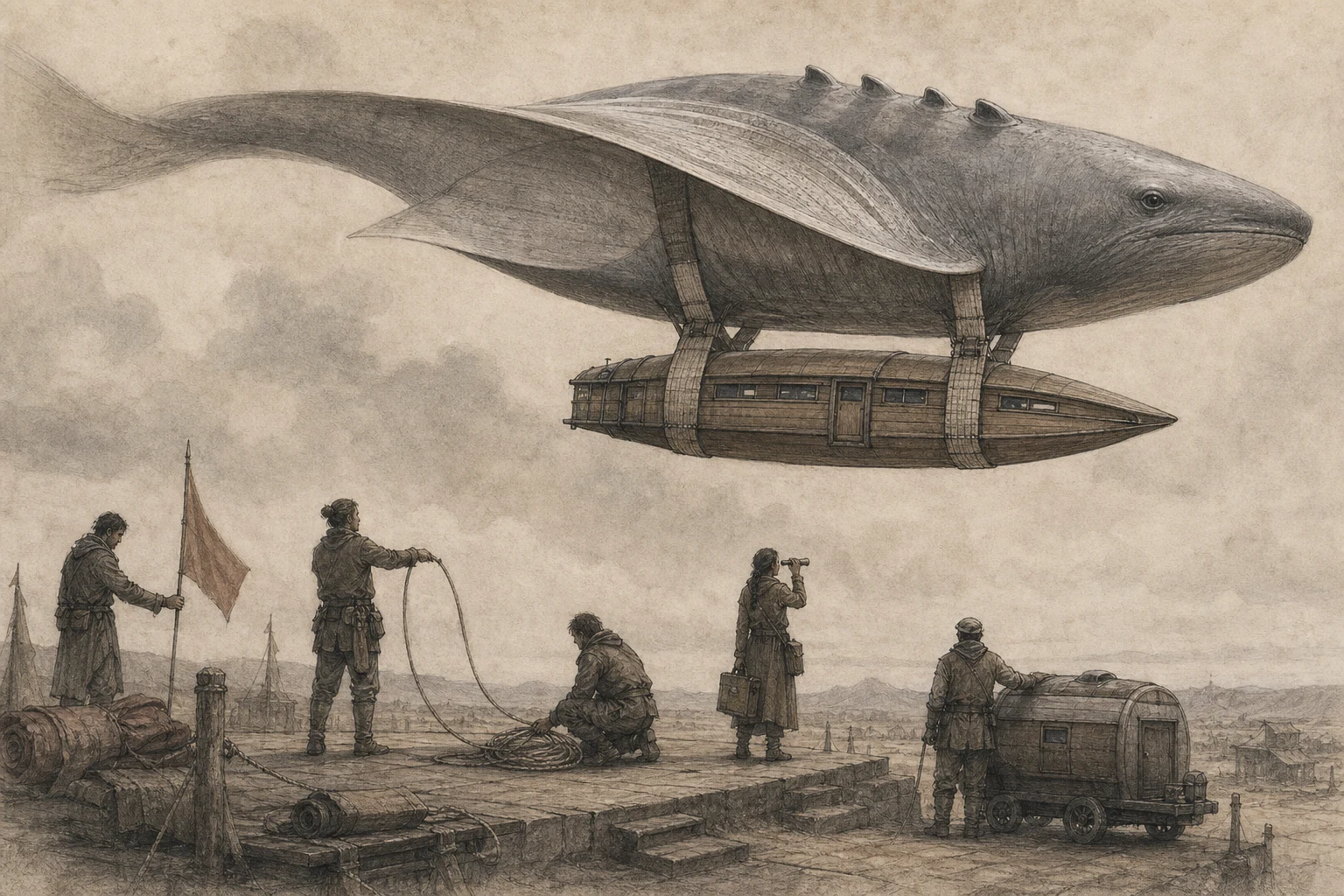
The caller gave the descent mark he had given every season of his working life. The bearer banked away instead. The keeper let the guide go rather than snub it, and the prepared module stayed on the ground.
Boundary Negotiated release, fore-and-aft travel, and modest non-piercing load bands are approved. Exact anatomy, scale, cabin, harness routing, flags, settlement, people, and location remain exploratory.
Graphite, charcoal, and a diluted wash on raw paper. The bearer is cropped and unresolved because the event outran the composition, and I have left it that way. The caller took a new bearing afterwards. He did not say anything.
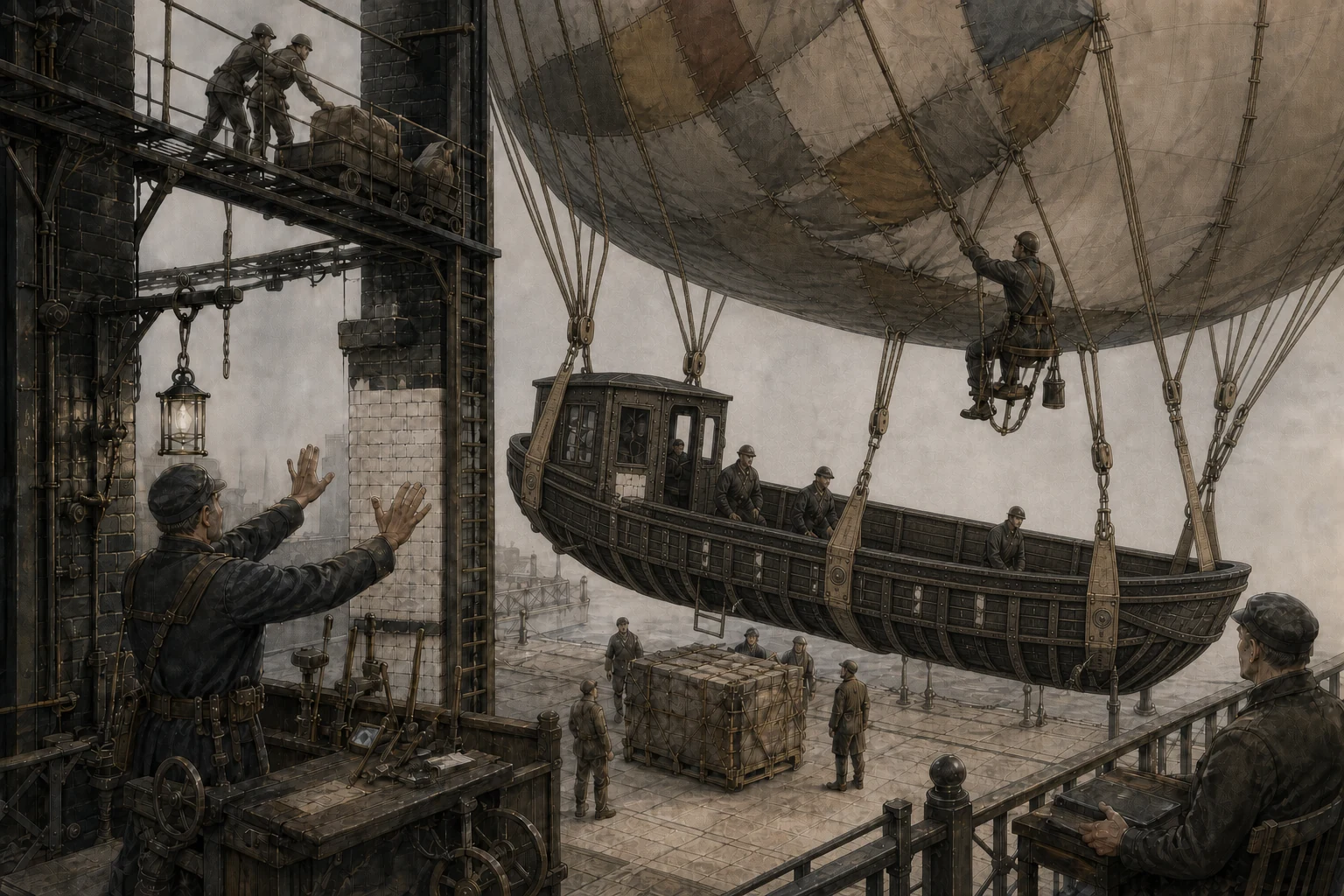
Removing the first dense crate lifted the aft gondola several handspans and began drawing an old repair out of one envelope gore. The master halted the unload. Customs waited, because balance outranks a manifest.
Boundary Envelope lift, trim interruption, ballast, and public patch repair are approved. Exact hull, suspension, patch, tilt, crew, owner, class, and lifting gas remain exploratory.
Hours of waiting, so: watercolour and gouache, with the ink following the load paths and the old stitching. Harrowmark repairs in public. It is not modesty; a patch everyone has seen is a patch somebody can be asked about.
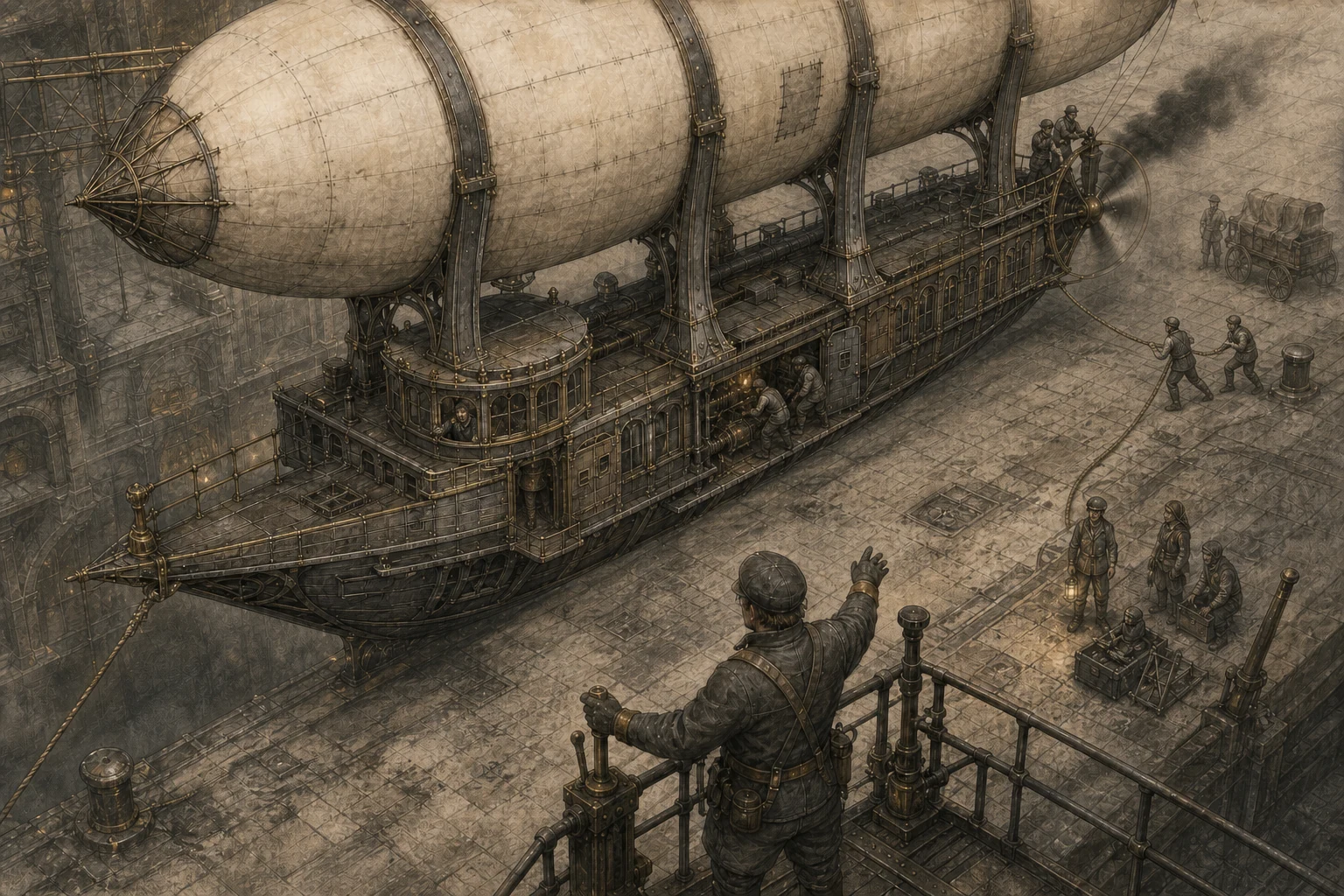
Twelve hours from Coldwater, and the bow line catches while the stern is still swinging. The second approach had overrun and been cancelled. Maintenance goes aboard before the cargo does.
Boundary Difficult steam mooring and its working infrastructure are approved. Exact vessel, class, ornament, machinery, route, crew, berth, and line plan remain exploratory.
Graphite, charcoal, iron-gall wash, and soot rubbed off the gantry rail, which is the only pigment that place supplies for free. The view crops on the right because I moved clear of the line. Eleven people were shouting and every one of them was correct.
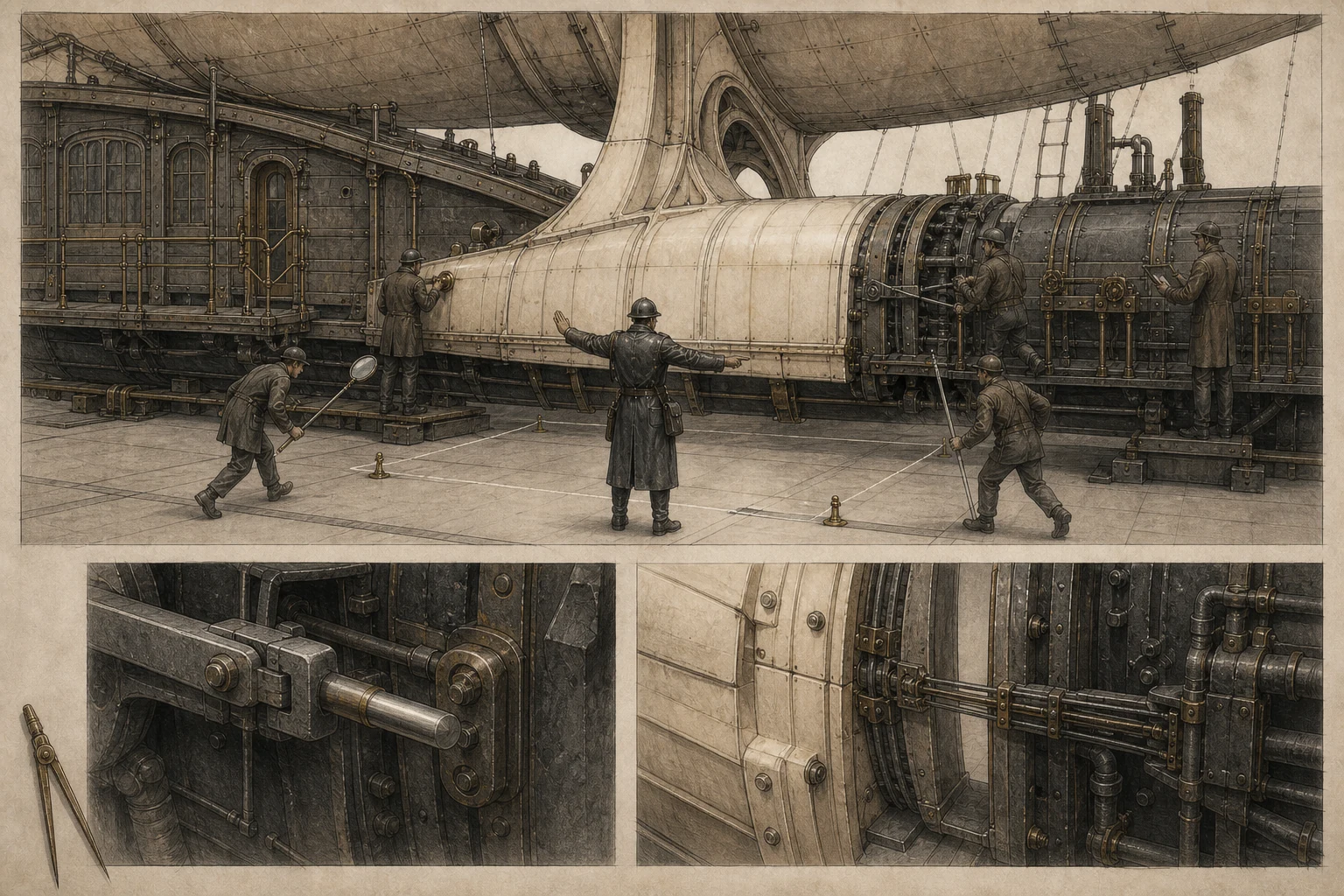
The steam side had been declared isolated and the crystal asked to hold neutral trim. An automatic correction tightened against a manually locked linkage, and the housing produced its first note. The marshal stopped the test.
Boundary The opaque hybrid interface and human test procedure are approved. Exact ship, housing, linkage, tools, people, interface geometry, and outcome remain exploratory.
Formal access, so ink and wash with two enlarged interface details. Note what the apprentices do at the sound: they are already moving. Nobody teaches that. Everyone learns it.
A crystal under stress makes a sound. One about to fail is a singer, and when a mechanic says the lift matrix is singing, everyone in earshot moves.
It is not taught. Tuners work by ear as much as by instrument, and the rest of the trade language follows the same habit: a crystal is willing or sour, and a tuner coaxes it. In the working world none of this gets called memory, whether or not the people using the words would recognise the description.
Four living traditions
A port is a social map before it is a skyline. Every silhouette arrives with money, history, and somebody else’s grudge already attached.
Soot, and eleven people shouting corrections
Either a large crew correcting continuously, or almost no correction at all
Two systems arguing inside one hull
Harness, breath, and a negotiation you can watch happen
A dull-crystal craft is twitchy, slow to answer, and fights its own trim. It carries a large crew riding the controls in shifts, and it docks in three attempts with a great deal of shouting. A quickened craft flies itself: precise, quiet, sometimes crewed by very few people, and it comes in on one approach, dead centre, correcting nothing. Neither requires its operator to cast spells.
So anyone who works a dock can price a vessel from the seawall without seeing a manifest, and they do it before the lines are made fast.
A beautiful landing is a confession.